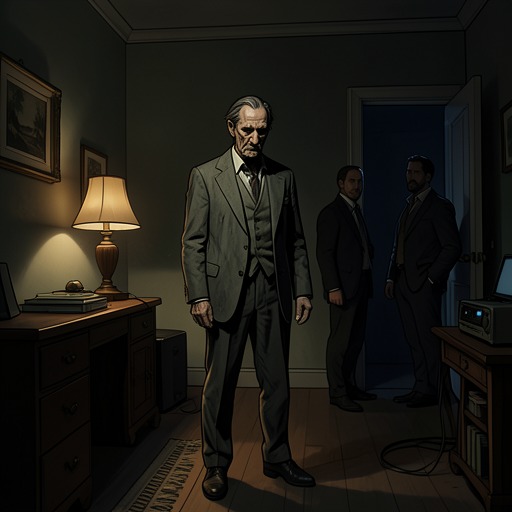
The Director is exposed as John’s father
Brave New WorldThe Director is exposed as John’s father in a public reversal that transforms an attempted dismissal into a scandal the Director cannot survive. At the Central London Hatchery and Conditioning Centre, Bernard counters the Director’s charges by presenting Linda and John; Linda identifies the Director as Tomakin, and John names him as his father. Because the World State regards motherhood and natural birth as abhorrent, the revelation is received not as an ordinary family disclosure but as an obscene joke—one that strips the Director of authority and drives him from his post.
The Director’s Accusation
The disclosure takes place after the Director summons the Centre’s workers and announces that Bernard has betrayed the trust placed in him. He cites Bernard’s unorthodox views on sport and soma, his sex life, and his failure to follow Fordian teachings. Presenting Bernard as a threat to social order, the Director proposes dismissing him and transferring him to Iceland, where he would have little opportunity to influence others. He then demands that Bernard give a reason why the judgment should not be carried out.
Bernard answers that he can, but that the reason is waiting in the passage. His reply reverses the terms of the confrontation: rather than defending himself with an argument, he opens the door and calls the evidence into the room. The workers’ attention shifts from the Director’s charge against Bernard to the personal history the Director has tried to keep outside the Centre’s public identity.
Linda Identifies Tomakin
Linda enters with Bernard beside her and recognizes the Director as Tomakin. She insists that she would have known him among a thousand, while asking whether he has forgotten her. Her first attempt to reclaim their shared past falters as she watches his expression; she calls to him again, her voice trembling, and reaches for him. The Director protests that the scene is a practical joke, but Linda insists that she is Linda and names the fact that makes their connection impossible to dismiss: he made her have a baby.
Her statement exposes a contradiction the World State’s institutions have suppressed. The Director is the head of a system that produces and conditions people through artificial reproduction; its procedures aim to make human development a matter of managed production rather than family life. The Centre’s doctrine calls the mass multiplication of embryos an instrument of social stability, and its technicians intervene in development, regulate fertility, and prepare embryos for predetermined social roles. Against that institutional order, Linda’s account identifies the Director as the biological father of a child born outside the system’s accepted norms.
John Names His Father
After Linda calls for John, he enters and crosses the room to the Director. He kneels before him and says, “My father!” The declaration confirms the relationship directly, but its force depends on the society’s taboo against parenthood: the word is treated as indecent, and its unexpected public use breaks the room’s tension into laughter. John’s act is at once recognition and exposure. He names a relationship that the World State’s language and customs have made nearly unsayable, making the Director’s private past audible to the whole Centre.
The response is not sympathy for Linda or John. The workers laugh at the spectacle and at the Director’s newly revealed connection to them, and the uproar grows when the phrase is repeated. The scene’s reversal is therefore social as well as familial: the Director had invoked order and stability to condemn Bernard, but the disclosure makes him the object of public ridicule. John’s words do not merely answer the charge against Bernard; they make the authority behind that charge untenable.
Resignation and Public Aftermath
The Director, pale and humiliated, covers his ears and rushes out. He resigns immediately afterward and never returns to the Centre. His proposed punishment of Bernard is thus overtaken by the revelation: the man who intended to dismiss and exile a subordinate loses his own office when his concealed past is brought into public view.
The aftermath also shows how differently the society regards John and Linda. Upper-caste London becomes eager to see John because his kneeling before the Director and calling him father is considered a sensational joke. Linda, by contrast, draws no comparable interest. Her motherhood is regarded as obscene, and her appearance further contributes to the public’s lack of desire to see her. The disclosure makes John a curiosity while leaving Linda socially discredited, revealing that the spectacle’s entertainment value does not undo the stigma attached to the mother.
Significance
The episode brings private biology into collision with the World State’s public language of manufacture, conditioning, and stability. The society can organize reproduction at scale—using processes that multiply embryos into batches of identical individuals and conditioning them for assigned roles—but it cannot make Linda’s pregnancy or John’s parentage conform to its official categories. The Director’s own place in the system does not protect him from that contradiction once Linda and John make it public.
Later, John questions why the society needs such large groups of conditioned twins when its bottles can supply whatever kinds of people it wants. Mustapha Mond defends the system by arguing that a society composed entirely of Alphas would be unstable and miserable. Against that defense, the exposure scene supplies the human consequence behind the abstract machinery: reproductive control may serve the state’s design, but the relationships it denies remain capable of returning as facts that unsettle its institutions. The revelation therefore defeats the Director personally while dramatizing the vulnerability of a social order that treats family ties as taboo.